
V-Scoring PCB (PCB Cut)
V-Scoring PCB, also called V-Groove PCB or PCB Cut, is a common panelization method used to separate individual boards from a production panel. It is suitable for many rectangular PCB designs and helps reduce processing cost while keeping assembly handling efficient.
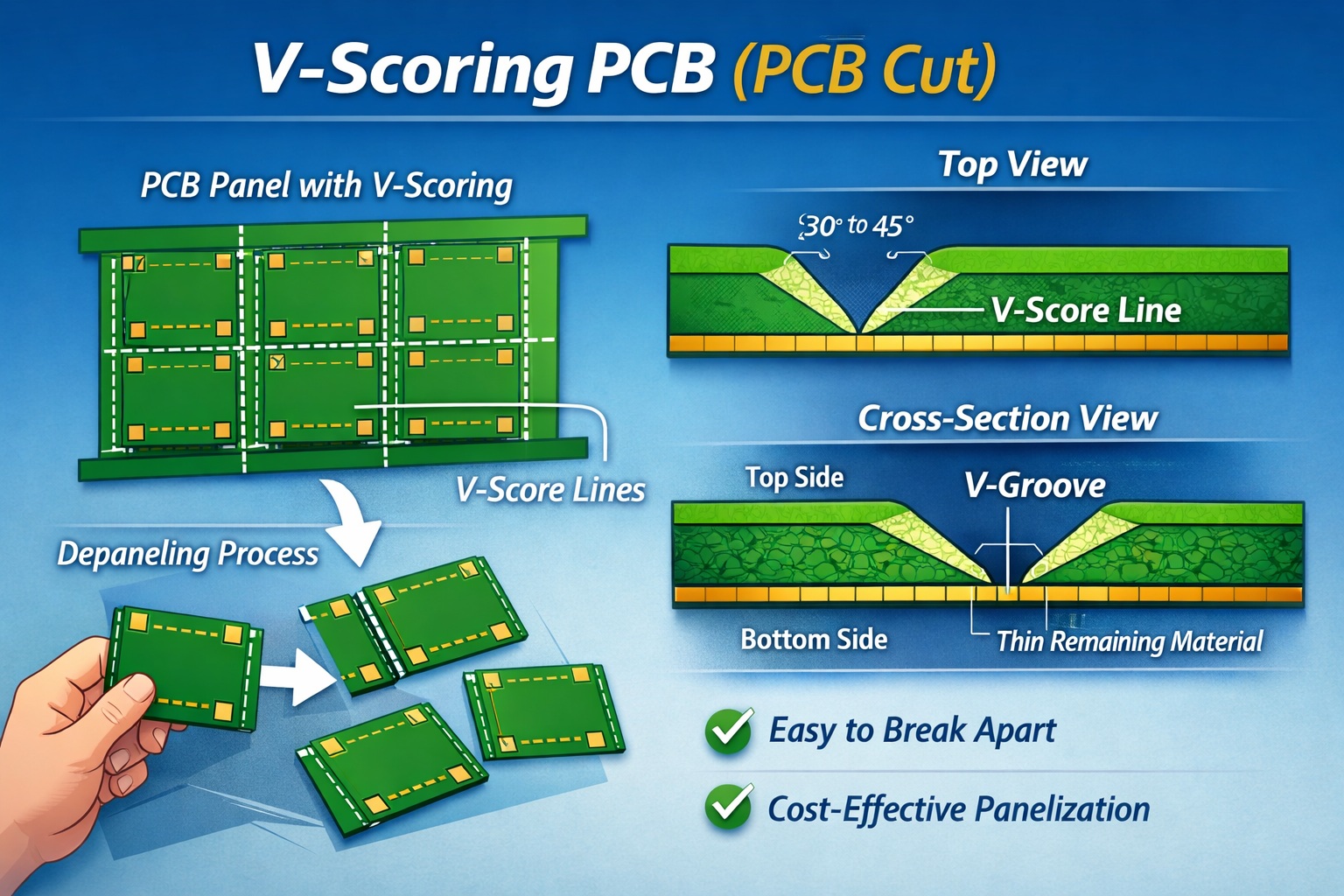
What Is V-Scoring PCB?
V-Scoring is a manufacturing process where V-shaped grooves are cut partially into the top and bottom sides of a PCB panel along a straight line. The remaining thin material allows the boards to stay connected during fabrication, SMT assembly, and shipping, and then be separated later by hand or by depaneling tools.
Main Alternative Names
- V-Scoring PCB
- V-Groove PCB
- Scored PCB
- PCB Cut
When Should You Use V-Scoring?
V-Scoring is usually a good option when the PCB outline is simple and the board edges to be separated are straight. It is commonly used for rectangular or square boards arranged in a panel.
| Condition | Recommendation |
|---|---|
| Board outline is straight | V-Scoring is usually suitable |
| Board shape is rectangular or square | V-Scoring is often preferred for lower panelization cost |
| Need efficient panel assembly | V-Scoring can simplify SMT handling and depaneling |
| Irregular board outline | Tab Routing may be a better choice than V-Scoring |
| Curved cut lines required | V-Scoring is not suitable; routing is normally required |
Advantages of V-Scoring PCB
- Lower panelization cost: V-Scoring is often more economical than routed tabs for simple board shapes.
- Clean panel arrangement: Boards can be placed closely together with minimal spacing.
- Efficient assembly handling: A full panel is easier to process in SMT assembly lines.
- Fast separation: Boards can be broken apart quickly after assembly.
- Good for volume production: Especially practical for repeated standard designs.
Important Design Notes
V-Scoring is useful, but it also has design limitations. To avoid manufacturing or depaneling problems, designers should consider the following points early in the PCB layout stage.
1. Score Lines Must Be Straight
V-Scoring is generally applied only along straight lines. If your board edge includes curves, slots, or complex contours, routing is usually required instead.
2. Keep Components Away from the Score Line
Components placed too close to a V-cut line may be damaged during depanelization. It is safer to leave enough clearance between the score line and nearby parts or copper features.
3. Consider Mechanical Stress
Separating V-scored boards may introduce bending stress. Fragile ceramic components, edge connectors, or fine pitch solder joints near the break line should be reviewed carefully.
4. Edge Quality After Separation
After the boards are broken apart, the edge may show a slight roughness or witness line. If your product requires smoother finished edges, routing may produce better results.
V-Scoring vs. Tab Routing
| Item | V-Scoring | Tab Routing |
|---|---|---|
| Cut line shape | Straight lines only | Straight or irregular outlines |
| Board spacing | Very small spacing possible | Usually requires tab connection space |
| Cost | Often lower for simple rectangular boards | May be higher depending on routing complexity |
| Edge finish after separation | May show scoring marks | Often smoother depending on route design |
| Irregular PCB shape | Not ideal | Usually better |
How to Quote / Order V-Scoring PCB
If your PCB requires V-Scoring, please make the panel requirement clear in your Gerber files, fabrication drawing, or order notes. If available, mark the V-cut lines clearly in the mechanical layer.
- Indicate that the board requires V-Scoring or V-Groove.
- Provide the panel layout if you already have a preferred panel arrangement.
- Mark the score lines on your fabrication drawing or mechanical layer whenever possible.
- Tell us if assembly process or special depaneling requirements should be considered.
Quick FAQ
Can any PCB use V-Scoring?
No. V-Scoring is best for straight-line panel separation. Irregular shapes usually need routing.
Is V-Scoring cheaper than routing?
In many simple rectangular PCB cases, yes. But the final cost still depends on the full board design, quantity, panel layout, and manufacturing requirement.
Can I place components near the V-cut line?
It is possible in some cases, but not recommended unless enough clearance is reserved and the depanelization stress is acceptable.